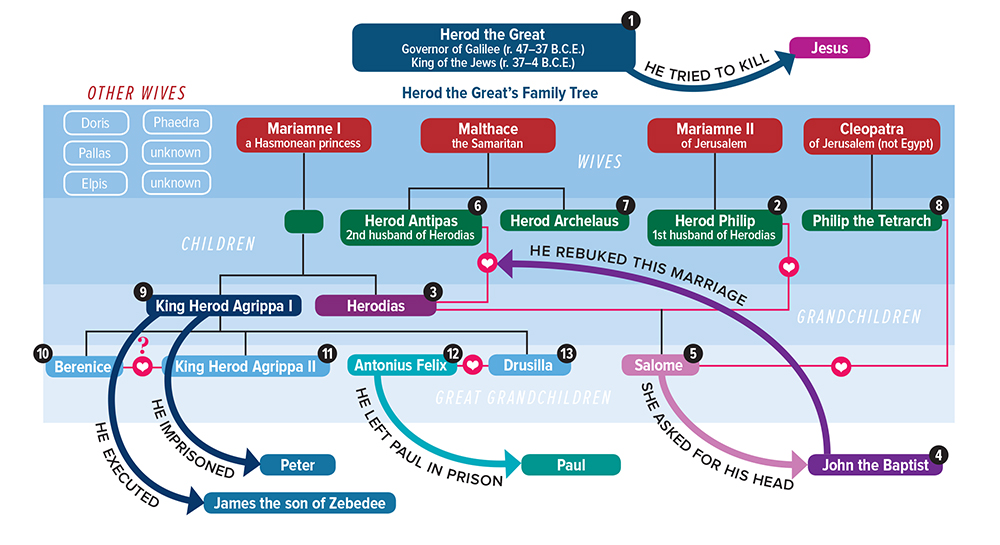
The death of John the Baptizer is mentioned to offer a context for the events surrounding Jesus’ ministry at this point in time. It’s like one of those flashbacks in one of today’s movies or TV programs that give a context for events presently taking place or about to take place in the program. Jesus had sent out his twelve apostles into the towns and villages of Galilee, as a kind of training exercise, and they were to preach the Gospel of the coming Kingdom of God. Matthew thematically records the event earlier in chapter ten of his Gospel narrative, but both Mark and Luke put the Twelve going out just prior to the death of John the Baptizer (Mark 6:7-13, cp. verse-14; Luke 9:1-6, cp. verse-7). All three of the Synoptics have Herod believing Jesus was John “risen from the dead” (Matthew 14:1-2)
We need to keep in mind, at this point, that no one in the first century AD had a true concept of what it meant to be raised from the dead, until Jesus’ own resurrection, concerning which Lazarus’ resurrection was a precursor. Herod’s mention of a resurrection probably meant the spirit of the Baptist had entered Jesus, or a reasonable facsimile. He had no real concept of what it meant to rise from the dead, and neither did anyone else living at that time. Both Lazarus’ resurrection and Jesus’ were a complete surprise to everyone who heard about them.
Next, we are offered some of the circumstances surrounding John’s arrest. Herod imprisoned John, not because he was offended in John’s testimony, but because Herodias was. It was for her sake that Herod arrested John (Matthew 14:3). It seems that Herod, and we must also assume that Herodias, was informed by “someone” that John claimed Herod was breaking the Law of Moses by taking his brother Philip’s[1] wife for his own. The event may have transpired in the following way or a reasonable facsimile.
The Jewish authorities felt they needed to get rid of John, due to their differences with him concerning purification (cp. John 3:25). Therefore, they plotted to get him in trouble with the Herodians by asking John the loaded question: “Was Herod’s marriage to Herodias valid?” John would have replied it wasn’t valid, and one or a small company of the Herodians would have told Herod, who may or may not have been in the company of Herodias at the time. In any event, it was Herodias who demanded that John be executed, and Herod imprisoned him to temporarily defuse the potentially perilous mood that possessed her.
John was arrested and brought to Herod and then imprisoned, because, when Herod questioned him, John admitted that he didn’t believe Herod’s marriage to Herodias was valid (Matthew 14:4). In other words, it was a simple statement of fact. The text doesn’t imply John was traveling the countryside accusing Herod of breaking the Law of Moses, but it was the scheme of the Pharisees used to get rid of John and bring his ministry to a halt.
While in a sound mind, Herod feared to do anything that would really harm John, because he believed it might cause a general uprising against him by the populace who viewed John as a prophet. Of course, Herod would be able to put down such a rebellion, but he would also have to answer to Caesar for such an uprising, and Herod’s brother, Archelaus, was removed from his office and exiled for reasons such as this. Therefore, he simply imprisoned John, without further harm (Matthew 14:5). Nevertheless, when Herod’s birthday arrived, he celebrated with his friends, and he wasn’t so sound in his judgment at the time, because he was very drunk. Herodias had patiently awaited this moment to take her revenge upon John. She had told her daughter to dance before Herod, and, knowing Herod’s drunken behavior, she advised her daughter to ask for John’s head in a platter. One can only imagine the suggestive attire and the sexual implications of the dance, but, when she was done, Herod offered her a reward; whatever she would ask he would give. When she asked for John’s head on a platter, Herod realized his error. Nevertheless, for his oath’s sake which was given publicly before his friends, he granted the request. To save face, he sent and had John beheaded, and his head was sent on a platter to his step-daughter, who then brought it to Herodias, her mother (Matthew 14:6-11). John’s body was then given to his disciples, who buried him. Afterward, they went and told Jesus (Matthew 14:12).
[1] This Philip was not the Tetrarch but the son of Herod the Great through Mariamne II of Jerusalem. Herod had two sons named Philip.